Saturday, 31 May 2014

A SETBACK WITH A SILVER-LINING!

Alas, my tour schedule and finalizing everything related to the book finally clashed and I won't have time to review the final proofs until I return from a tour to NW India in mid-July. The first lot of proofs were wonderful overall with just a few tweaks here and there and whilst I don't expect anything major to be wrong with the next batch we all felt - that is the publishers, Basak and I - to rush things at this crucial stage was pointless for the sake of a month or so. There are still some little refinements for Basak to work on too and the upshot is the book won't reach the shelves until the middle of October rather than early September as was planned - although perfect timing for Christmas shopping! I know I said May in my last post but various delays and the fact that the books have to come from China, meant August was actually the earliest we could have hoped for in the end. We also got to see the jacket design and the people at IB Tauris have done a superb job, combining stunning displays of gentians, crocuses and irises - but I can't say which or reveal the design yet.

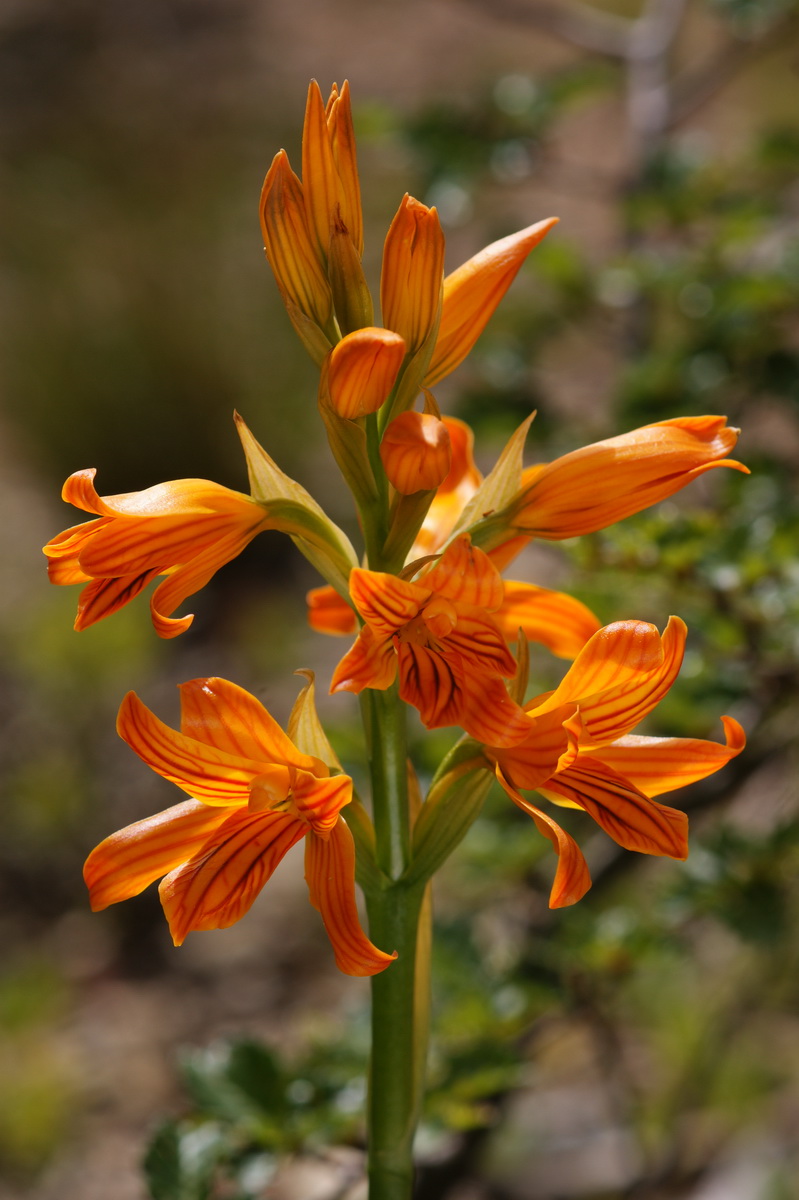
However, every cloud has the proverbial silver-lining. For a while we had accepted it isn't possible to include every amazing flower from the Silk Road in our 540 species and we felt it didn't want for much if anything as it stood (Iris korolkowii and Ostrowskia magnifica would have been nice but alas no).  However, there was one more persistent niggle and the only flowers in the book we felt we hadn't done justice to were the west Asian lilies - especially the Turkish ones.  I'd missed out on Lilium polyphyllum in India last year when new building work had erased the location, Lilium ledbourii from Iran was never really on the travelling agenda and most significantly we never had the chance to be in the north-east of Turkey at the right season. This is set to change in late-June when we are undertaking a research trip for a tour in 2015 for the Lily Society/Mediterranean Garden Society to see the Turkish lilies.  This will give me the chance to photograph five species of these stunning flowers and given the nature of the digital age it also means I can include some last-minute, stop press images for the book. Lilium akkusianum is the species I most want to include, a localised endemic and the loveliest of the showy trumpet lilies in Turkey.  Lilium ciliatum is also on the agenda and fingers crossed if I get decent weather and good plants then these two will feature in the book - the cherry on the cake.  Below are images of Lilium ponticum one Turkish species I have seen with rich yellow and purple flowers and there's also Lilium duchartrei from Gansu, which has more than a passing resemblance to Lilium ledebourii cited above.


Lilium ponticum

Lilium ledbourii

Tuesday, 22 April 2014

A NEW SPECIES - BELLEVALIA CHRISII


Despite centuries of plant hunting and botanical science many new are plants are still being described and I’m sure many of us would love to discover a beautiful new flower or to have one named for ourselves.  Well I’m delighted to say I now have the honour of both.  In 2010 I visited the little explored Anti-Taurus Mountains near Malatya.   The tour I was leading with Basak had been delayed by the infamous Icelandic volcano so we arrived in May rather than April.  Searching for flowers on a pass I came across a small bellevalia with distinctive broad leaves which was quite unlike any I’d seen before.  Searching further afield we came across more and better specimens.  A couple were collected and despatched to the botanical garden in Istanbul, but nothing happened with these.  In 2012 I returned to the same location, this time with the experienced and respected Turkish botanist Mehmet Koyucu and I showed him the bellevalia, which were in fine flower at the time and he quickly came to the same conclusion as me that they represented something new.  Again a few more were collected and this time they were looked at thoroughly.  Initially it was thought to be a form of Bellevalia glauca (known from northern Iraq – a long way away) but closer examination by a team of four Turkish botanists – Hasan Yildirim, Yusuf Altioğlu, Bilal Şahin and Serdar Aslan - suggested it was not this species and it has now been formerly described as the new and rare Bellevalia chrisii.  It is closely related to Bellevalia crassa and rixii and is known only from the type locality.  Worrying for me is the small population of only a couple of hundred plants – I could easily go extinct!  In fact I have genuine concern – upon the discovery of Sternbergia candida in the 1970s within no time many were offered for sale and hundreds stripped from accessible locations.  Anyone offered this species in the next few years can be sure they were stolen from the wild, so please don’t buy them I’d like to last a while longer!

Naturally the species features in the Flowers of the Silk Road which is now due for publication in May.  Below are three images of ‘my treasure’ at its’ best.

Chris Gardner, 22nd April 2014


Sunday, 1 September 2013

AT LAST!!!

First of all sorry for nothing appearing here for a long while, but we’re now delighted to announce that we have finally signed a contract with IB Tauris for the publication of the book with an estimated publication date of May 2014.  It’s been a long wait, but that’s not without its benefits as we have been able to improve on some photos and also visit some new areas and add to overall coverage.  A couple of star plants have still eluded me though, but in truth you could go on forever and at some point the decision needs to be made to stop and go with what we have...which is a lot.  However, one weird and wonderful I finally caught up when I visited Himachal Pradesh in July was Saussurea gossypiphora a woolly alpine from the Himalayas and China, which I found growing with cushions of white-flowered Androsace delvayi and masses of tiny pink Primula minutissima on the floriferous Rohtang La.  This north-west Indian state is adjacent to the legendary flower valleys of Kashmir and the saussurea grew there with many other superb alpines including the very choice and deliciously fragrant Primula reidii.. In the semi-arid Spiti Valley were incredible stands of Codonopsis clematidea and way up on the Baralacha La the bulky hard cushions of Thylacospermum caespitosum and the big daisy Waldheimia tomentosa.  Why include the flowers from here?  Simple, both Kashmir and Pakistan are decidedly out of bounds right now but all of the flowers we chose to include do occur there so although the landscapes are not quite the same it gives a good floral flavour of what is found in these areas.  A pic of the Hunza Valley would have been nice though!  I also visited southern Kyrgyzstan in June including the verdant walnut forest at Arslanbob.  But what knocked me out here were the towering Eremurus robustus growing on the forest edge and in clearings. In fact there were some staggering eremurus displays with hundreds of thousands of Eremurus tianshanicus in places.  The alpine flora was even better than I remembered this year with fabulous Trollius lilacinus bursting through the late snow - magical.

On top of this we have now formed our own travel agency Vira Natura (let’s go to nature), based in Turkey.  However, we intend to do tours not only here but in other areas of the Silk Road so please check the website for details at www.viranaturatours.com.  Next year we will be offering a trip along the Anatolian Diagonal and beyond to eastern Turkey and will soon have a full Silk Road program as well as many Turkish flower and walking trips and other tours to more unusual areas including some which combine walking and botany to the Rwenzori Mountains of Uganda, Chile and the table lands and Andes of Venezuela to name but a few.  


Below is a selection of my favourite images from Himachal Pradesh and two from Kyrgyzstan too:


Codonopsis clematidea, Pin Valley


Geranium pratense, Spiti Valley


Meconopsis aculeata, Miyar Valley


Morina longifolia, Kinnaur Valley


Pedicularia bicornuta, Miyat Valley


Baralacha view


Primula reidii, Rohtang La


Saussurea gossypiphora & Androsace delavayi (white form), Rohtang La


Spiti Valley


Waldheimia tomentosa, Baralacha La


Eremurus robustus, Arslanbob


Trollius lilacinus, Chon Ashu Pass

Wednesday, 30 May 2012

SECOND CHANCES

Admittedly we’ve been a bit quiet on the blogging front of late but hopefully things will soon pick up again.  Hopefully we now have a publisher and the intention is to have the book on the shelves by next spring.  A long way off we know but these things take time and with our absentee lifestyle we’re not in a position to work on the book full time.  However, this has its compensations and the last few months have seen Chris able to work on improving some images and also capturing some new ones worth considering.  Snowdrops (and thousands of other bulbs) were superb across north-west Turkey this spring and plentiful rains in sourthern Uzbekistan meant impressive foxtail lilies and tulips, whilst central Turkey produced the goods yet again with Fritillaria alburyana, the recently named Iris peshmenii and countless other mountain gems from gentians and pasque flowers to stately Iris kirkwoodiae and cliffs plastered with Saxifraga kotschyi.  All of these yielded worthwhile pictures and most will be included.  Added to this we are now in the process of describing a new species of bellevalia we discovered in the region two years ago (see post 22nd April 2014). 

However, one unfortunate recent development in Turkey is the now regular hassle we attract from would-be ‘officials’ who now readily inform the authorities of our presence on the hills which at times results in lengthy discussions and delays to ‘clear’ our names.  It all stems from one ill-informed and over blown newspaper/television feature on foreigners digging up bulbs (allegedly the last fifty Fritillaria michailovskii - although in actual fact there are many thousands left) and now we are all tarred with the same brush.  Of course there have been and continue to be illegal collecting activities in Turkey but most visitors are well-behaved and hopefully this attitude will ease off with time but be prepared for confrontation if exploring on your own – you are being watched.

Below is a selection from the above second chance visits. 
Galanthus gracilis

Kalon mosque and minaret, Bukhara

Tulipa micheliana

Eremurus albertii

Astragalus macrocephalus

Bellevalia chrisii

Fritillaria alburyana

Fritillaria persica

Gentiana verna

Iris kirkwoodiae

Iris peshmenii

Pulsatilla albana

Pulsatilla albana

Saxifraga kotschyi

Monday, 9 January 2012

RETURN FROM CHILE

This was my fourth visit to southern Chile and floristically the best so far with good rains in the drier northern deserts and amazing weather courtesy of El Nina.  I was travelling with professional photographer Heather Angel who is working on an exciting new book on pollination for Kew (Royal Botanic Garden) and there were some key plants we had to find.  The first was the remarkable Puya bertroniana a large spiny-leaved terrestrial bromeliad that is actually very common in Chile but erratic in its flowering.  The areas south of La Serena yielded few good puyas, but there was the amazing cactus Eriosyce aurata with rings of purplish-red and white flowers that looked like marshmallows and raspberries and because of the rains the remnant cloud forests of Fray Jorge National Park has many gorgeous Alstroemeria magnifica all over the place.  We did catch up with an amazing specimen of Puya bertroniana at Siete Tazas a park near Curico, which had huge spikes crowded with turquoise-blue flowers with prominent ‘bird-perches’ poking out and several times we watched Austral Blackbirds feeding on the flowers, sitting comfortably just as the plant intended. 

The Embothrium coccineum were the best I’d ever seen with shrubs absolutely hidden beneath scarlet flowers and the orchids were as sensational as ever too especially Chloraea magellanica and I finally caught up with Chloraea nudilabia a stunning golden species at Nahuelbuta.  However, the highlight of the trip was the discovery of a new pass which was awash with amazing flowers with gravely flats studded with hundreds of clumps of Oxalis adenophylla in perfect condition.  There were also the handsome straw-yellow flowers of Pachylaena atriplicifolia, incredible tall stands of deep-pink and golden-orange Schizanthus grahamii that marched along the roadsides, sprawling stems of golden-yellow Tropaeolum polyphyllum snaked across the screes and tall pink Alstroemeria ligtu was in super abundance carpeting the slopes mingled with bushes of bright yellow Calceolaria thyrsiflora as thousands of chirping cicadas filled the airwaves.  Finally at Torres del Paine National Park on one occasion we awoke to a perfectly calm morning with the magnificent sculpted peaks of Cuernos del Paine perfectly reflected in the limpid mirror waters of Lago Pehoe, a rare event at this time of year.

As a flower destination Chile is right up there with the best and I can't recommend it highly enough despite the appalling road signing.  However, I'll be back to Asian flowers soon enough with half a dozen trips planned for the spring/summer period.

Alstroemeria ligtu

Alstroemeria magnifica 

Araucaria araucana woodland

Chloraea nudilabia

Conanthera bifolia

Cuernos del Paine

Embothrium coccineum

Eriosyce aurata

Oxalis adenophylla

Pachylaena atriplicifolia

Puya bertroniana

Schizanthus grahamii

Tropaeolum polyphyllum

Azorella monantha in habitat


PUBLISHER CHASE

We knew it would never be easy to find our publisher, although for a time it did seem that Timber Press were interested, but in the end they decided it wasn’t for them!  But we’ve certainly not given up and will contact more publishers during the next couple of months as we want this unique collection of images to be available for all to see. 

Wednesday, 12 October 2011

ORCHIDS OF CHILE

We’ve been fortunate to see many wild hardy orchids around the world especially in Europe and Asia and standout examples would be fields of Orchis palustris in eastern Turkey, Ophrys-rich limestone in southern Greece and the amazing Cypripedium of China especially Cypripedium lichiangense with its big spotted leaves and bizarre flowers.  However, of equal merit yet perhaps much less well-known are the stunning orchids of Chile.  What we find remarkable about these is partly the size, as they almost all possess individually large flowers, but also the curious lip protrusion and grooves that feature on most species.  This is obviously an aid to pollination of some sort (usually carried out by bees or sometimes flies) and Chris's leading a trip there in December with a photographer armed with an ultra-violet camera and we expect some interesting patterns to be revealed.  Also they only come in three colours – yellow, white or green which suggests a limited pollinator choice, but the photographs may reveal more.  Chris expects to find at least twenty species on the trip and some species are very widespread with such tall spikes that they are easily seen along the roadsides, although others such as the decidedly odd Bipinnula apinnula require some searching.  Our personal favourite is the porcelain orchid Chloraea magellanica which occurs in the southern half of the country – we’ve seen it at Reserva Nacional Siete Tazas near Curico and thriving hundreds of kilometres south in Patagonia in Parque Nacional Torres del Paine where it grew in abundance with yellow Gavilea lutea.  Siete Tazas has some other great orchids too including the flamboyant Chloraea galeata

Another good location Parque Nacional Nahuelbuta is one of the world’s special places a magnificent surviving enclave of monkey puzzle Araucaria araucana forest, the tall architectural trees festooned lichens with their understorey harbouring some choice species of orchid too, not to mention superb meadows of Chloraea volkmannii and stands of tall golden Chloraea lamellata in the surrounding area.  There are many other superb plants here too with the pendant branches of Berberis linearifolia appearing as golden-orange waterfalls of flowers among the southern beech trees (our favourite shot from last years’ tour) and streamsides choked with Ourisia poepigii.  The atypical Chloraea nudilabia eluded me last year due to a camera malfunction so Chris hopes to bag it this time around.  What’s atypical is it lacks the protrusions found on the lips of all the other species.

Chile is a superb floral destination but it’s also a long, long country and at least a month is needed to get to grips with the flora.  As such we’ll be guiding alternate tours there from now on with Greentours http://www.greentours.co.uk/ with Northern Chile and Southern Chile variants.  The singular blue of Puya bertroniana is one of the northern highlights, but others include wonderful Alstroemeria, Malesherbia lirana and many cacti with big showy flowers, favourites with the Giant Hummingbirds.

Berberis linearifolia

Berberis linearifolia at Nahuelbuta

Chloraea alpina

Chloraea barbata

Bipinnula apinnula

Chloraea magellanica

Gavilea odoratissima

Puya bertroniana